
Simple pipe cleaner flowers are a great place to start if you’re new to this craft. With just a few colorful pipe cleaners and basic twisting techniques, you can make daisies, spiral flowers, tulips, roses, and other easy designs.
In this beginner-friendly guide, you’ll discover 10 easy pipe cleaner flower ideas, the basic materials you need, and simple tips for shaping cleaner petals and stems.
If this is your first time working with chenille stems, start with our basic flower pipe cleaner guide. For child-friendly projects, see our easy pipe cleaner flowers for kids guide.
Why Simple Pipe Cleaner Flowers Are Good for Beginners
Simple pipe cleaner flowers are ideal for beginners because they use basic shapes and simple twisting techniques. You can learn how the material bends and holds its shape without starting with complicated designs.
These beginner projects are especially useful because they:
- use only a few easy-to-find materials
- require no advanced shaping techniques
- can be completed relatively quickly
- help you practice basic twisting and bending
- are easy to adjust if the petals do not look right the first time
Starting with simple flowers also gives you room to experiment with different colors, petal sizes, and shapes. As you practice, your twists become more consistent and shaping the petals becomes easier.
Once you’re comfortable with these basic techniques, you can move on to more detailed pipe cleaner flowers such as roses, tulips, sunflowers, and small bouquets.
Materials for Simple Pipe Cleaner Flowers
You do not need a large supply list to start making beginner pipe cleaner flowers. In fact, keeping materials simple helps you focus on technique instead of tools.
Colorful pipe cleaners
Pipe cleaners are the main material for all easy pipe cleaner flower projects. Choose soft, flexible ones in bright or pastel colors. For beginners, standard-sized pipe cleaners are easier to control than extra-thick versions.
Scissors
A basic pair of scissors is useful for trimming pipe cleaners to shorter lengths. Clean cuts make shaping petals and stems much easier, especially when working on simple pipe cleaner flower ideas for beginners.
Optional small beads
Small beads can be used for flower centers. While optional, they add contrast and make DIY pipe cleaner flowers for beginners look more polished. If you skip beads, a tightly twisted center works just as well.
Green pipe cleaners
Green pipe cleaners are useful for making flower stems and leaves. Keep a few aside so you can attach your finished flower heads to stems and add simple leaf shapes.
With just these few materials, you can create dozens of simple flower pipe cleaner crafts without extra cost or preparation.
10 Simple Pipe Cleaner Flower Ideas for Beginners
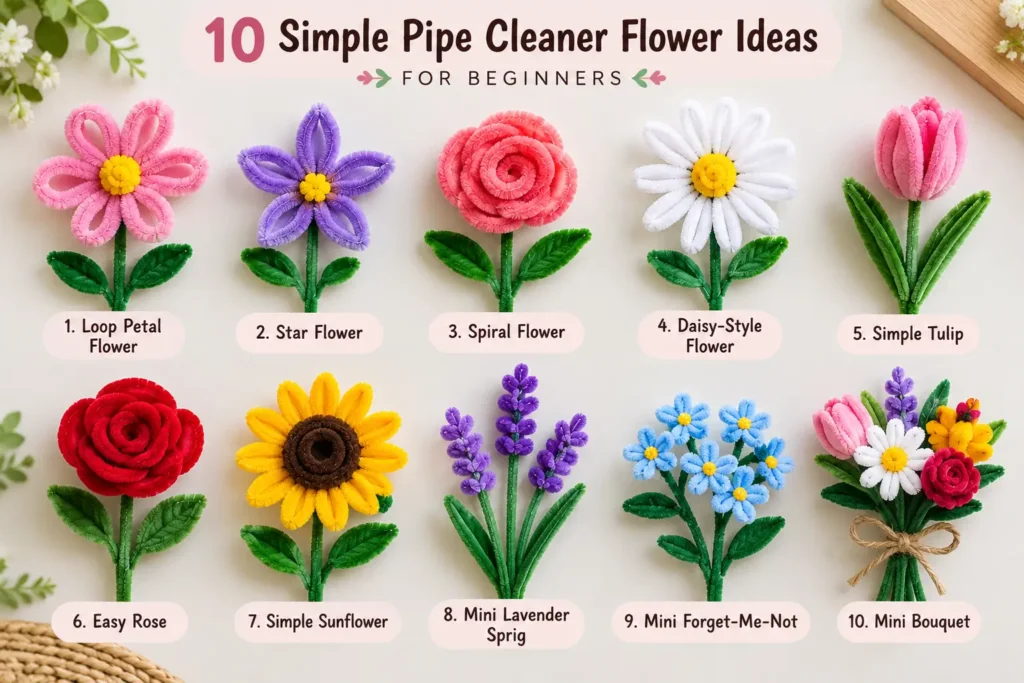
These simple pipe cleaner flower ideas for beginners focus on basic shapes that are easy to repeat and adjust. Each design teaches a small skill while still producing a finished flower you can display or gift.
1. Loop petal flower
The loop petal flower is one of the most popular beginner pipe cleaner flowers. Start by twisting the center, then form several rounded loops around it. Because the petals are smooth and flexible, this design is very forgiving and works well in any color combination.
2. Star flower
The star flower uses pointed loops instead of rounded ones. By creating five evenly spaced points, beginners learn how to control spacing and symmetry. This is a great step up from the loop petal flower and adds variety to easy pipe cleaner flower projects.
3. Small spiral flower
For this design, twist one pipe cleaner into a loose spiral shape. Gently bend the outer edge outward to give it a soft, blooming look. This flower helps beginners understand tension and flow, which are useful skills in DIY pipe cleaner flowers for beginners.
4. Simple daisy-style flower
The daisy-style flower uses longer petals arranged evenly around a center. Adding a small bead or tightly twisted middle creates contrast and definition. This classic design is perfect for simple flower pipe cleaner crafts and looks great in small bunches.
5. Simple Tulip
Fold a colorful pipe cleaner into a small tulip-shaped bloom and twist the base around a green stem. Keep the petals slightly rounded for a simple, recognizable shape. For the complete tutorial, follow our pipe cleaner tulip
6. Easy Rose
Coil a pipe cleaner into a loose spiral, then gently shape the outer layers to create a simple rose. Attach the base to a green stem by twisting the ends together. For a more detailed version, follow our pipe cleaner rose tutorial.
7. Simple Sunflower
Make several yellow loops around a brown center, then attach the flower head to a green stem. Keep the petals evenly spaced for a cheerful sunflower shape. For the complete tutorial, follow our pipe cleaner sunflower step-by-step guide.
8. Mini Lavender Sprig
Use a purple pipe cleaner to create several small loops or twists along the top of a green stem. Make a few matching stems and group them together for a miniature lavender arrangement. For more ideas and detailed instructions, see our lavender pipe cleaner flowers guide.
9. Mini Forget-Me-Not
Create five small rounded petals around a tiny center, then attach the flower to a thin green stem. Make several small flowers together to create a delicate cluster. For the complete tutorial, see our pipe cleaner forget-me-not guide.
10. Mini Flower Bouquet
Combine three or more of your finished beginner flowers, arrange the stems at slightly different heights, and twist the stems together near the bottom to create a simple mini bouquet. For more inspiration and arrangement ideas, see our pipe cleaner flower bouquet ideas guide.
If you’re completely new to pipe cleaner flowers, start with the loop petal flower or daisy. Once you’re comfortable making loops and twists, move on to the tulip, rose, sunflower, and other shaped flowers.
How to practice these beginner flower designs

The best way to improve your flower-making skills is through simple, repeated practice.
Start by making the same flower several times in a row. Repetition helps your hands learn how much pressure to use when twisting and bending. Over time, your movements become smoother and more consistent, which improves the final look of your easy pipe cleaner flower projects.
Next, experiment with different colors. Changing colors keeps the process interesting and helps you see how the same shape can look completely different. You can also slightly adjust petal size to understand how proportion affects balance.
Finally, try different center finishes. Use beads, tight twists, or layered centers to add variation. These small changes help build confidence and prepare you for more creative DIY pipe cleaner flowers for beginners without adding complexity.
By practicing simple flower pipe cleaner crafts this way, improvement happens naturally and without frustration.
Easy Ways to Use Your Pipe Cleaner Flowers

Once you’ve made a few simple pipe cleaner flowers, you can use them in many easy decorating projects. Place a few flowers in a small jar or pencil holder for colorful desk decor, or attach a single flower to a greeting card or gift package for a handmade touch.
You can also group several flowers together for a small decorative arrangement in a bedroom, craft room, or on a shelf. Try combining different flower shapes and colors to create seasonal displays or simple matching sets.
Tips for Better-Looking Pipe Cleaner Flowers
When working on simple pipe cleaner flower ideas for beginners, small adjustments can make a big difference. These tips help your flowers look cleaner and more balanced without adding difficulty.
First, avoid twisting too tightly at the beginning. Tight twists can make the pipe cleaner hard to bend later and may distort the shape. Instead, use gentle twists and adjust as you go.
Next, try to keep petals similar in size. While perfection is not necessary, even spacing and length make beginner pipe cleaner flowers look more polished. Laying petals flat before shaping can help with consistency.
Use soft bends instead of sharp folds. Rounded curves create a more natural flower appearance and prevent the pipe cleaner from kinking. This technique is especially useful in easy pipe cleaner flower projects.
Finally, practice one shape at a time. Mastering a single design builds confidence and makes learning new DIY pipe cleaner flowers for beginners much easier later on.
Frequently Asked Questions
How long does it take to make one beginner flower?
Most simple pipe cleaner flower ideas for beginners take about 3 to 5 minutes to complete. As you practice, beginner pipe cleaner flowers often take even less time because the steps become familiar and smoother.
Are these beginner designs suitable for children?
Yes. Many simple pipe cleaner flower designs can be adapted for children. Younger children should be supervised, especially when scissors are used or when pipe cleaner wire ends are exposed. For age-appropriate ideas, see our easy pipe cleaner flowers for kids guide.
Can I mix beginner flowers with other pipe cleaner designs?
Absolutely. Simple flower pipe cleaner crafts combine well with more detailed designs like roses or small bouquets. Mixing DIY pipe cleaner flowers for beginners with advanced styles adds variety while keeping the overall decoration balanced.
What is the easiest pipe cleaner flower to make?
A loop-petal flower or simple daisy is a good starting point for beginners because both designs use basic loops and twists. Once you are comfortable shaping the petals, you can try roses, tulips, and sunflowers.
How many pipe cleaners do you need to make a simple flower?
Most simple pipe cleaner flowers can be made with two to four pipe cleaners, depending on the flower size and number of petals. You may also want one green pipe cleaner for the stem and leaves.
Conclusion
Simple pipe cleaner flowers are an easy way to learn the basic twisting, looping, and shaping techniques used in more detailed flower crafts. Start with a loop flower or daisy, then gradually try roses, tulips, sunflowers, lavender, and other designs as your skills improve.
Once you’ve practiced a few flowers, combine different shapes and colors to create mini bouquets, gifts, or handmade decorations.