
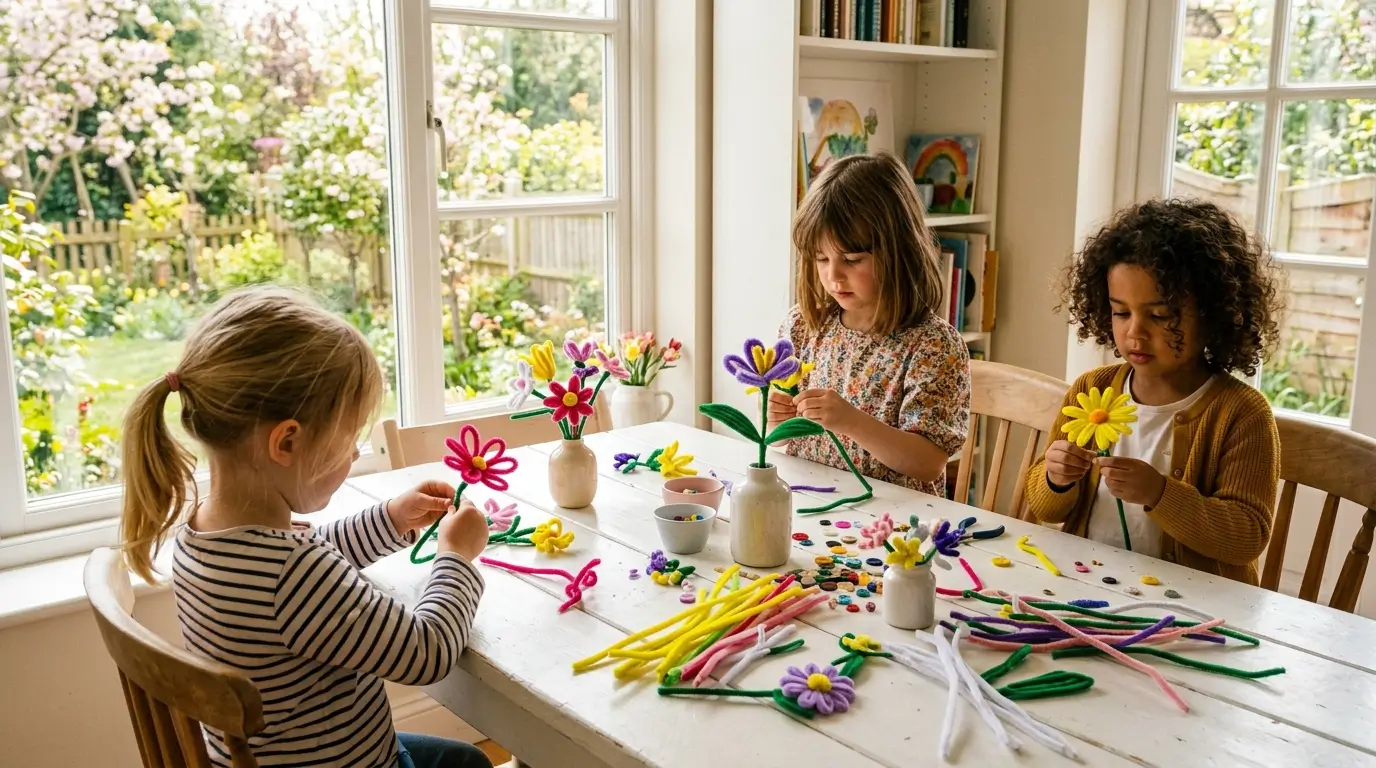
Spring is in the air — and there’s no better way to celebrate it than making colorful flowers with your kids.
This guide brings you 10 easy spring pipe cleaner flowers craft for kids of all ages, from toddlers to tweens. Every design uses only pipe cleaners, takes less than 10 minutes per flower, and requires zero glue, zero mess, and zero craft experience.
Whether you’re a parent looking for a rainy afternoon activity, a teacher planning a spring flower craft for preschool, or just someone who loves beautiful, budget-friendly DIY — you’re in the right place.
🌸 Why spring? Spring is the season of flowers. Making them in pipe cleaner form means your kids get to explore colors, shapes and textures while building fine motor skills — and the result lasts all year long.
Why Pipe Cleaner Flowers Are the Perfect Spring Craft for Kids
Before we dive into the 10 designs, here’s why pipe cleaner flowers work so well for children specifically:
- Safe for all ages — no scissors needed for most designs, no hot glue, no toxic paint
- Builds fine motor skills — twisting and coiling strengthens small hand muscles
- Endlessly customizable — kids choose their own colors, sizes and styles
- Cheap and accessible — a full pack costs $1–3 at Dollar Tree or Hobby Lobby
- Results look amazing — children feel proud because the flowers actually look beautiful
- Connects to nature — great springboard for talking about real flowers, seasons and gardens
For even more beginner-friendly designs, check out our full collection of easy pipe cleaner flowers for kids.
What You Need for All 10 Designs
Good news: every single flower in this guide uses the same basic supply list.
Supplies:
- Pipe cleaners in spring colors — yellow, pink, white, purple, orange, green
- Small scissors — only needed for a few designs, and only by adults
- A pencil or chopstick — optional, for making uniform coil shapes
- A small vase or jar — for displaying the finished bouquet
Where to buy: Dollar Tree, Hobby Lobby, Michaels, or Amazon Cost per bouquet: Under $3 Time per flower: 3–8 minutes depending on design
10 Easy Spring Pipe Cleaner Flowers for Kids
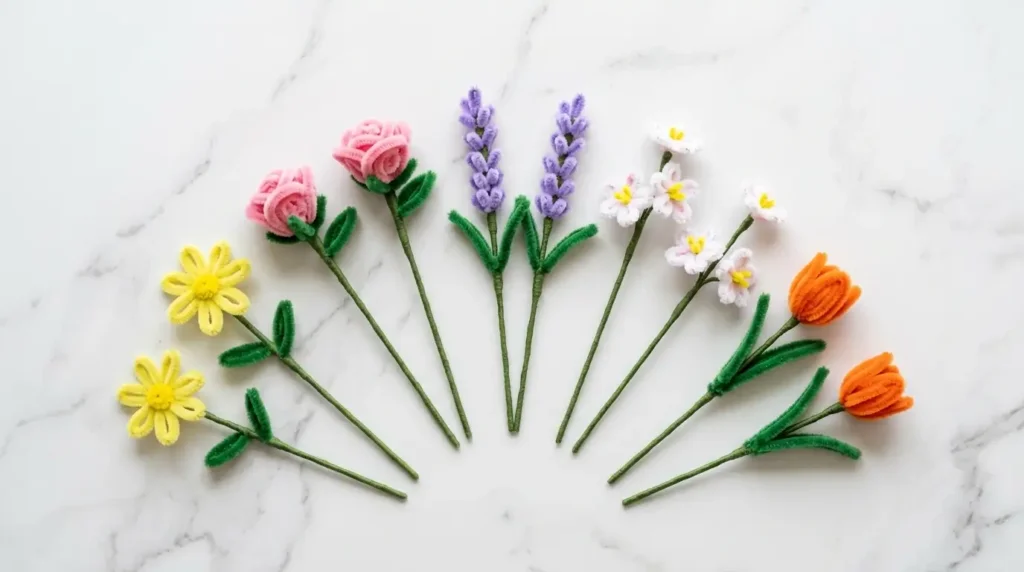
🌼 1. Classic Spring Daisy
Age group: 3+ · Time: 5 minutes · Difficulty: ⭐
The daisy is the most iconic spring flower and one of the easiest to make. Cut 6 short white pieces (about 4 cm each) and arrange them in a circle around a small yellow coil center. Twist the ends together at the back to secure all petals.
Add a long green stem twisted at the base, plus two small green leaf loops halfway down.
This is the perfect first flower for toddlers — just hand them the yellow center coil and let them press the white petals around it with your help.
Full step-by-step photos available in our dedicated pipe cleaner daisy flower guide.
🌷 2. Cheerful Spring Tulip
Age group: 5+ · Time: 5 minutes · Difficulty: ⭐⭐
Wrap a pink or orange pipe cleaner around your index finger 3 times. Slide the loops off carefully and pinch the top into a rounded cup shape — that’s your tulip head. Twist a green pipe cleaner stem at the base and add one long curved leaf.
The tulip is the most recognizable spring flower and looks stunning in a mixed bouquet next to daisies and roses.
🌹 3. Spring Rose
Age group: 6+ · Time: 6 minutes · Difficulty: ⭐⭐
Coil a pink or red pipe cleaner tightly in a flat spiral from the outside in, like a snail shell. Secure the center by twisting the end upward. Add a green stem and two small leaf loops.
The tighter your coil, the more realistic the rose looks. For kids under 8, pre-start the coil and let them finish tightening it themselves.
See the complete rose tutorial in our pipe cleaner rose step-by-step guide.
💜 4. Lavender Sprig
Age group: 5+ · Time: 4 minutes · Difficulty: ⭐
Take a green pipe cleaner for the stem. Twist tiny purple loops (about 1 cm wide) all the way up the top third of the stem, leaving the bottom two-thirds bare as the handle. Pinch each loop into a small pointed bud shape.
Lavender sprigs add height and color variety to any bouquet and are one of the quickest flowers to make.
🌸 5. Cherry Blossom Branch
Age group: 7+ · Time: 8 minutes · Difficulty: ⭐⭐⭐
This one is slightly more advanced but looks absolutely beautiful. Twist a brown pipe cleaner into a small Y-shaped branch. Then make 4–6 tiny pale pink 5-petal flowers (each petal just a 2 cm folded loop) and twist them onto the branch tips.
Cherry blossom branches are perfect for a Japanese-inspired spring display and look gorgeous in a tall narrow vase.
🌻 6. Mini Sunflower
Age group: 6+ · Time: 6 minutes · Difficulty: ⭐⭐
Wrap 8 yellow pieces around a small brown center coil as petals. The yellow pieces should each be about 5 cm and bent slightly outward at the tips for a natural petal curve. Add a long green stem with two large oval leaves.
Mini sunflowers bring an instant pop of sunshine to any spring arrangement. They pair beautifully with daisies and lavender.
🔵 7. Forget-Me-Not Cluster
Age group: 5+ · Time: 5 minutes · Difficulty: ⭐⭐
Make 5 tiny blue 5-petal flowers using the same method as cherry blossoms but even smaller. Cluster them all onto one short green stem so they bloom together like a real forget-me-not bunch.
These are perfect as filler flowers in a bouquet — they add volume and color depth between the larger statement flowers.
🟣 8. Simple Wildflower
Age group: 4+ · Time: 4 minutes · Difficulty: ⭐
Take one pipe cleaner and fold it in half 4 times to create 8 equal-length segments. Pinch the center with your fingers and twist twice — the loops naturally fan out into a wildflower shape. Add a green stem.
This is the fastest flower in this list and the best choice for very young children who want an immediate result.
🌿 9. Spring Lily
Age group: 8+ · Time: 8 minutes · Difficulty: ⭐⭐⭐
Shape 6 white pipe cleaners into long, graceful curved petals, each one about 8 cm. Twist the bases together around a central yellow stamen (a short folded yellow piece). Spread the petals outward and downward for the classic lily silhouette. Add a long green stem with 2 thin leaves.
The lily is the most elegant spring flower in this collection and makes any bouquet look sophisticated. See more arrangement ideas in our small pipe cleaner flower arrangements for home decor.
🌺 10. Spiral Zinnia
Age group: 7+ · Time: 7 minutes · Difficulty: ⭐⭐⭐
Coil a bright orange or hot pink pipe cleaner into a very tight flat spiral (tighter than the rose). Instead of securing the center upward, leave the outer ring loose and flare the edges gently outward in alternating up-and-down directions. This creates the layered zinnia effect.
Zinnias are the boldest, most colorful flower of the spring collection and look stunning as the centerpiece of a mixed bouquet.
How to Make a Full Spring Bouquet
Once your kids have made a few flowers, it’s time to assemble them into a real bouquet. Here’s how:
Step 1 — Choose 5–7 flowers in complementary spring colors. Mix sizes: 1–2 statement flowers (rose, lily, zinnia), 2–3 medium flowers (tulip, daisy, sunflower), and 1–2 filler sprigs (lavender, forget-me-not).
Step 2 — Arrange by height — tallest flowers at the back, shortest at the front. Hold them loosely in your non-dominant hand while you arrange with your other.
Step 3 — Bundle the stems — wrap floral tape or a green ribbon around the stems starting halfway down. Finish with a bow.
Step 4 — Place in a vase — fill the bottom of a small jar with pebbles, marbles or rice to hold the stems upright.
For even more bouquet design inspiration, explore our pipe cleaner flower bouquet ideas collection.
Tips by Age Group
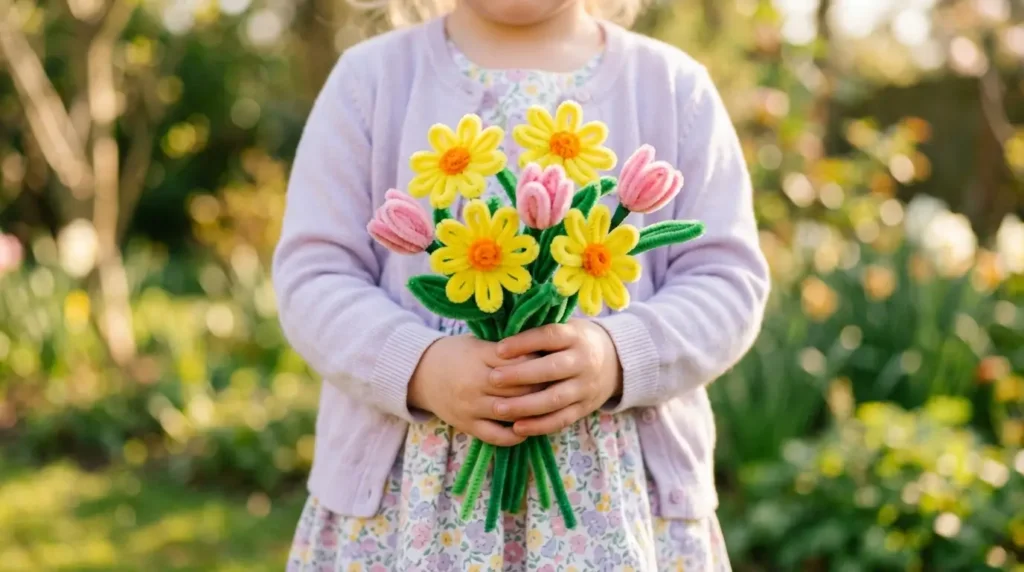
Every age can participate — just adapt the flowers and the level of independence.
Ages 3–5 (Preschool & Toddler) Start with the wildflower (Design 8) and the daisy (Design 1) with adult help. Focus on the coiling motion — it’s the core skill and they love the repetition. Pre-cut pipe cleaners to the right lengths the night before. Our flower pipe cleaner beginner guide has more ideas at this level.
Ages 6–8 (Early Elementary) The tulip, rose and mini sunflower are perfect at this age. Kids can work independently with minimal supervision. Challenge them to make 3 different flowers and assemble their own small bouquet.
Ages 9–12 (Upper Elementary & Tweens) Ready for the lily, cherry blossom and zinnia. At this age, kids enjoy the complexity and precision. Let them design the whole bouquet from scratch. See our pipe cleaner flower crafts for teenagers for more advanced challenges.
Display Your Spring Bouquet
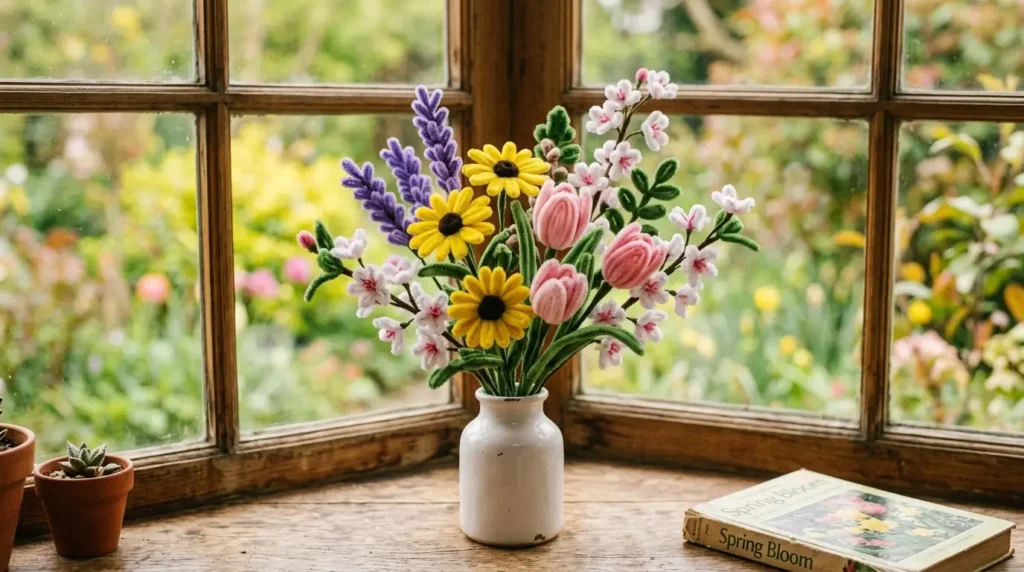
The finished bouquet deserves a beautiful home. Here are our favorite spring display ideas:
On a windowsill — the natural backlight makes the colors glow beautifully. Best spot in the house.
In a classroom — each student makes 2–3 flowers and contributes to one big class bouquet for the teacher’s desk. A perfect end-of-spring-term activity. See our full pipe cleaner flowers classroom decoration guide for more classroom ideas.
As a wall display — pin the flowers onto a corkboard or foam board in the shape of a spring wreath or garden scene. Pairs perfectly with our pipe cleaner flower wall decoration ideas.
In a sensory bin — bury the stems in dried rice or sand in a shallow tray. Kids can rearrange them endlessly — great for toddler play.
As a gift — wrap the bouquet in craft paper with a ribbon. Instant spring gift for a teacher, grandparent, or friend.
Classroom Craft Session: How to Run It
If you’re a teacher planning a flower craft preschool or elementary session, here’s the exact setup that works best:
Before the session:
- Pre-cut pipe cleaners to 3 standard lengths: 15 cm (petals), 8 cm (small petals), 30 cm (stems)
- Sort by color into small cups or trays, one per table group
- Choose 2 flower types maximum per session — daisy + tulip is the easiest combo
During the session:
- Start with the daisy (5 minutes) — immediate success builds confidence
- Move to the tulip (5 minutes) — slightly more complex, keeps them engaged
- Last 10 minutes: assemble into a mini bouquet and place in a small cup
Total time: 25–30 minutes including setup and cleanup
Ideal class size: Works for groups of up to 30 with 2 adult helpers
Frequently Asked Questions
What is the easiest spring pipe cleaner flower for preschoolers?
The wildflower (Design 8 in this guide) is the absolute easiest — it takes 4 minutes, requires no scissors, and every child aged 3 and up can make it independently with minimal guidance.
Do kids need scissors to make pipe cleaner flowers?
Most designs in this guide require no scissors at all. For the few that involve trimming, an adult can pre-cut the pieces beforehand so children never need to use scissors during the activity.
How many pipe cleaners does one bouquet need?
A 5-flower spring bouquet typically uses 15–20 pipe cleaners including stems and leaves. One standard pack of 100 pipe cleaners ($1–3) is enough for 5–6 full bouquets.
Can toddlers (ages 2–3) really make pipe cleaner flowers?
With adult guidance, yes! The key is to do the twisting for them and let the toddler push petals into place and choose colors. The participation — not the precision — is what matters at that age.
How long do pipe cleaner flowers last?
Forever, if kept dry and away from direct sunlight which can slightly fade colors over time. Unlike real flowers, they never wilt, need no water and can be handled and rearranged as many times as the kids want.
Are pipe cleaners safe for young children?
Standard craft pipe cleaners are non-toxic and safe for children aged 3 and up. For children under 3, supervise closely as the wire inside is firm and the ends can be sharp if broken. Pre-bend any sharp wire ends before giving them to very young children.
Final Thoughts
Spring is the season that reminds us how beautiful simple things can be — a daisy, a tulip, a child’s hands making something from scratch.
These 10 spring pipe cleaner flower crafts give kids a creative, tactile, screen-free way to celebrate the season. And when they’re done, the bouquet they’ve made will sit on a shelf or windowsill and keep spring alive a little longer.
Happy crafting — from My Flower Decor! 🌱
Loved this guide? Save it to Pinterest and share it with other parents and teachers! 📌
More ideas you’ll love: