
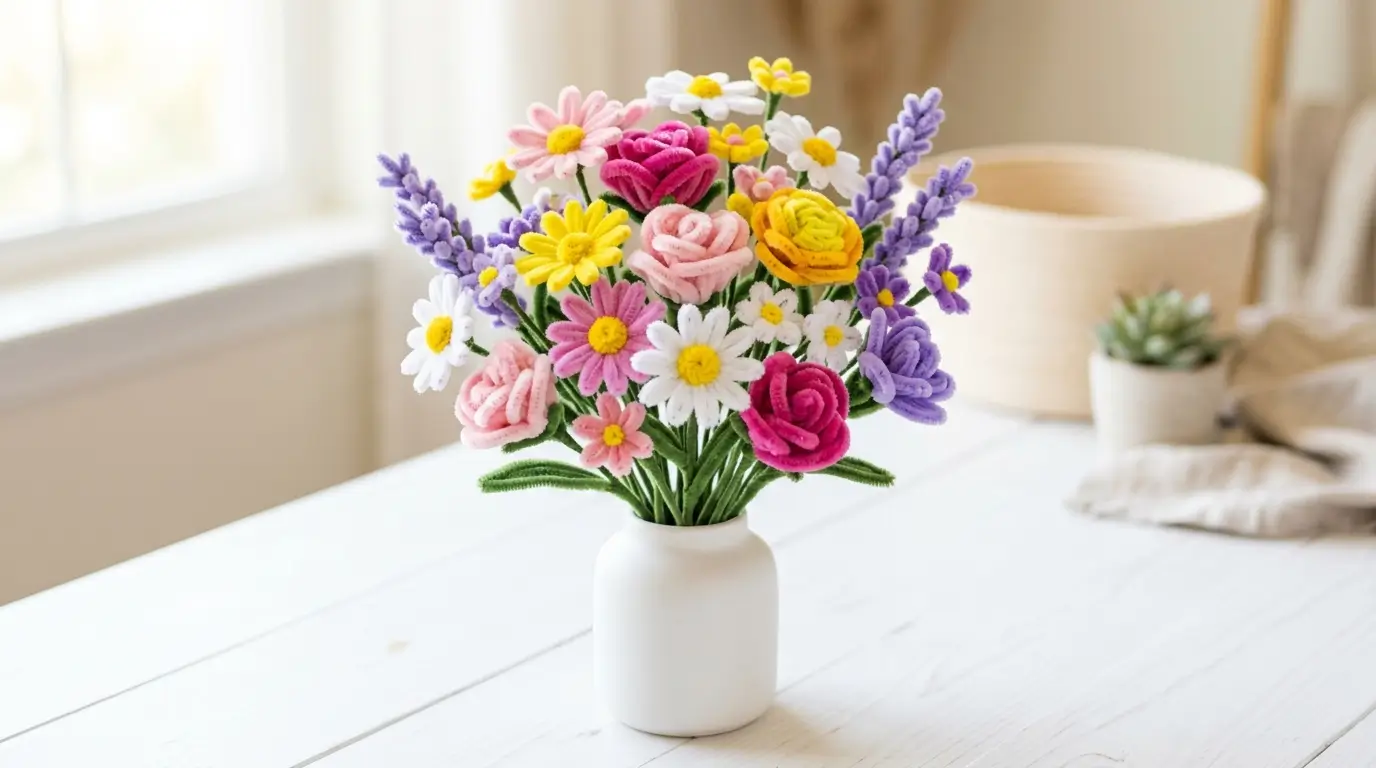
Here’s the truth most pipe cleaner tutorials don’t tell you: you never needed the glue gun.
Every single pipe cleaner flower in this guide is made with zero glue — no hot glue, no craft glue, no glue dots. Just pipe cleaners and your hands. And the results look just as beautiful, hold just as well, and last just as long.
This matters especially if you’re crafting with young children — no burns, no sticky mess, no waiting for glue to dry. But it also matters for beginners who don’t own a glue gun, or anyone who just wants the simplest possible craft experience.
In this guide you’ll find 10 no-glue pipe cleaner flower designs, the exact twisting techniques that replace glue entirely, and all the tips you need to make flowers that stay together permanently — without a single drop of adhesive.
These 10 designs are just the start. See the full range of types of pipe cleaner flowers — 20+ flower types sorted by category and difficulty — to plan your next project.
💡 Already comfortable making flowers? See how these no-glue designs combine into a full bouquet in our pipe cleaner flowers bouquet guide.
Why No Glue Works Perfectly for Pipe Cleaner Flowers
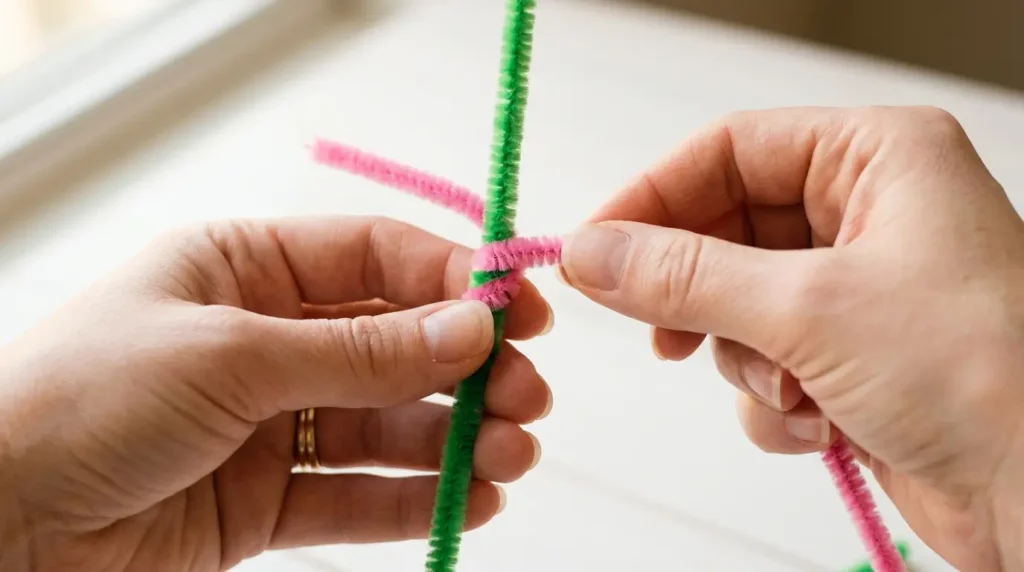
Glue was never the right tool for pipe cleaners. Here’s why twisting works better in every way:
Pipe cleaners grip themselves. The fuzzy chenille fibers create natural friction when two pipe cleaners are twisted together. One firm twist holds more securely than a drop of craft glue — and it’s flexible, so it doesn’t crack or peel over time.
Twisting is adjustable. Made a mistake? Untwist and redo in seconds. Dried glue gives you no second chances.
No waiting. Glue needs drying time. Twisting is instant — your flower is finished the moment you make the last twist.
Safe for all ages. Hot glue burns are one of the most common craft injuries for children. No glue means no risk, period.
No equipment needed. A glue gun costs money and needs electricity. Pipe cleaners alone cost $1–3 at Dollar Tree or Hobby Lobby.
The only time glue genuinely helps is when combining pipe cleaners with non-pipe-cleaner materials — attaching a flower to a hair clip, for example, or adding a button center. For pure pipe cleaner flower making, glue is completely unnecessary.
The 3 Core No-Glue Techniques
Every flower in this guide uses a combination of these three techniques. Master these and you can make any pipe cleaner flower without glue.
Technique 1 — The Anchor Twist
Wrap the end of one pipe cleaner around another at least 3 full rotations. This is how you attach petals to a stem, a leaf to a branch, or any two pieces together. Three rotations = permanent hold.
Technique 2 — The Coil
Wrap a pipe cleaner tightly around itself in a flat spiral. The pipe cleaner grips its own fibers as it coils, locking itself in place without any adhesive. This is the basis of the rose, the zinnia and the spiral flower.
Technique 3 — The Loop-and-Pinch
Fold a pipe cleaner into a loop and pinch the two ends together tightly while twisting. The twist locks the loop closed. This is how you make individual petals that hold their shape permanently.
10 Pipe Cleaner Flowers No Glue Required
🌹 1. No-Glue Rose
Age: 6+ · Time: 5 min · Technique: Coil
Coil a pink pipe cleaner tightly in a flat spiral from outside in. When you reach the center, fold the last centimeter upward to lock the coil. Attach a green stem using the Anchor Twist (3 rotations at the coil base). Add two leaf loops halfway down the stem.
This is the most satisfying no-glue flower because the coil holds itself completely — no glue could do it better.
Full step-by-step photos in our pipe cleaner rose tutorial.
🌼 2. No-Glue Daisy
Age: 4+ · Time: 5 min · Technique: Loop-and-Pinch + Anchor Twist
Cut 6 equal white pieces (about 5 cm each). Fold each into a small petal loop using Loop-and-Pinch. Arrange all 6 around a small yellow coil center. Twist all the petal ends together at the back using Anchor Twist — no glue needed to hold the petals in place.
The full no-glue daisy method is detailed in our pipe cleaner daisy flower guide.
🌷 3. No-Glue Tulip
Age: 5+ · Time: 4 min · Technique: Coil + Loop-and-Pinch
Wrap a pipe cleaner around your index finger 3 times, slide off the loops, and pinch the top together into a cup shape. The layers hold themselves — no glue needed. Attach a straight green stem using Anchor Twist. Done in under 4 minutes.
🌻 4. No-Glue Sunflower
Age: 6+ · Time: 7 min · Technique: Loop-and-Pinch + Anchor Twist
Make 8 yellow petal loops using Loop-and-Pinch. Arrange them in a circle around a small brown coil center. Twist all petal ends together at the back firmly. The brown coil sits on top, held in place by the petal twist. Bold, bright and completely glue-free.
💜 5. No-Glue Lavender Sprig
Age: 4+ · Time: 3 min · Technique: Loop along stem
Take a long green pipe cleaner. Starting from the top, twist tiny purple loops directly onto the green stem every 1 cm. Each loop is secured by the twist around the stem — no glue, no pins, nothing. The fastest flower in this list.
🌿 6. No-Glue Wildflower
Age: 3+ · Time: 3 min · Technique: Center Fold
Fold a pipe cleaner in half 3 times. Hold the center and twist once — the loops fan out naturally into a wildflower. This is the absolute easiest no-glue flower for very young children. See our easy pipe cleaner flowers for kids guide for more toddler-friendly designs.
🌸 7. No-Glue Cherry Blossom
Age: 7+ · Time: 7 min · Technique: Loop-and-Pinch + branch twist
Make a small brown Y-branch by twisting two brown pipe cleaners. Create 4–5 tiny 5-petal pink flowers using Loop-and-Pinch, then Anchor Twist each flower onto a branch tip. Delicate and completely glue-free.
🔵 8. No-Glue Forget-Me-Not Cluster
Age: 5+ · Time: 5 min · Technique: Loop-and-Pinch + cluster twist
Make 5 tiny blue 5-petal flowers. Cluster all their twisted bases together and twist them onto one short green stem as a group. The cluster twist creates a unified hold — stronger than glue on something this small.
🌺 9. No-Glue Spiral Zinnia
Age: 7+ · Time: 6 min · Technique: Tight Coil + edge curl
Make a very tight coil (tighter than the rose). Instead of securing the center upward, leave it flat and gently curl the outer ring edges alternately up and down with your fingertip. The coil tension holds the zinnia shape permanently without any adhesive.
🌾 10. No-Glue Wheat Stem
Age: 5+ · Time: 4 min · Technique: Loop along stem
Twist small teardrop-shaped yellow loops along the top 5 cm of a long green or brown stem, alternating left and right. Looks like a wheat stalk or abstract grass. Perfect filler for a wildflower bouquet and one of the easiest no-glue designs to make.
Best No-Glue Flowers for Young Kids
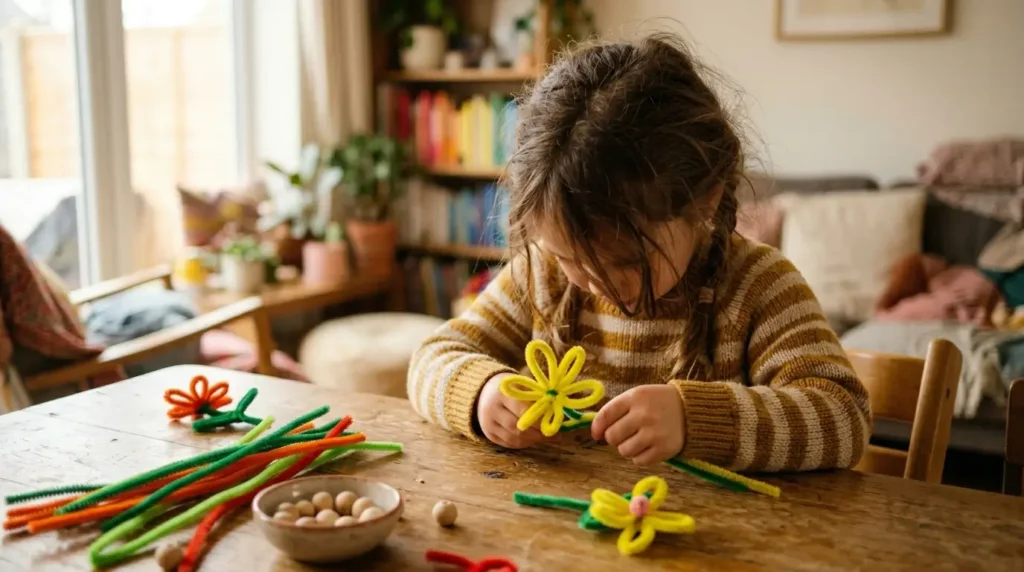
Not all 10 flowers above are equal for young children. Here’s the honest breakdown by age:
Ages 3–4 — Start here: The Wildflower (Design 6) is the only design truly independent at this age. Three folds and one twist. That’s it. Let them pick the color and make the twist with your guidance.
Ages 4–5 — Add these: The Lavender Sprig (Design 5) and Daisy (Design 2) are within reach with light adult support. Pre-fold the petals and let them do the final assembly.
Ages 6–8 — Full independence: The Rose, Tulip and Sunflower (Designs 1, 3, 4) can be made completely independently. These are the sweet spot — rewarding results, manageable complexity.
Ages 9+ — Full collection: All 10 designs. Challenge them to make every flower and assemble the complete no-glue bouquet.
For a full age-by-age craft plan, see our pipe cleaner flower crafts for teenagers for older kids.
No-Glue vs Glue: Does It Make a Difference?
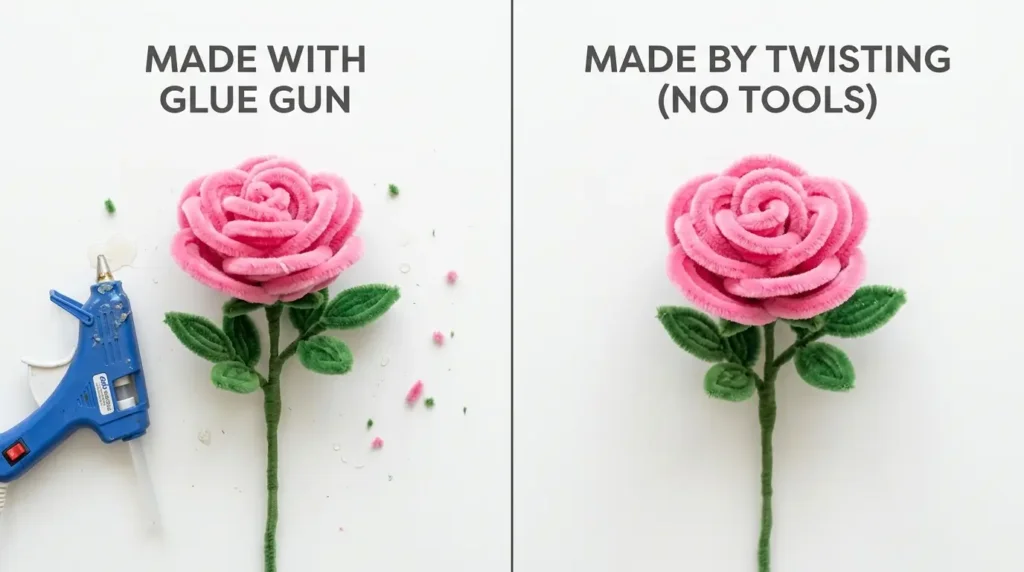
Let’s settle this once and for all.
Appearance: Side by side, a twist-secured flower and a glue-secured flower look identical. The fuzzy texture of pipe cleaners hides the connection point completely.
Durability: A 3-rotation Anchor Twist is as permanent as dried glue — and more flexible. It won’t crack when the flower is handled or bent.
Safety: No-glue wins completely. No burns, no toxic fumes, safe for every age.
Speed: No-glue wins. No drying time, no setup, no cleanup.
Reversibility: No-glue wins. You can untwist and redo. Glue is permanent from the moment it sets.
The only edge case for glue: attaching a pipe cleaner flower to a non-pipe-cleaner surface — a headband, a hair clip, a wooden frame. In that specific scenario, a tiny drop of glue or hot glue makes the attachment more secure. Everything else? Twist it.
How to Make a Full No-Glue Bouquet
Once you have 5–7 no-glue flowers ready, assembling the bouquet is exactly the same as any pipe cleaner bouquet — because the bundling and display technique uses zero glue anyway.
Follow the full stand-up assembly method in our pipe cleaner flowers bouquet guide — floral tape for bundling, pebbles for anchoring, and you’re done.
For simple at-home display ideas once your no-glue bouquet is ready, our small pipe cleaner flower arrangements for home decor has plenty of inspiration.
Classroom and Group Craft Tips
The no-glue method is specifically designed for group settings. Here’s how to run a smooth session:
Preparation (night before): Pre-cut pipe cleaners to 3 standard lengths: 15 cm (full pieces), 8 cm (half pieces for petals), 4 cm (short pieces for small petals). Sort by color into small cups, one per table.
Session flow: Start with the Wildflower (3 min) → move to the Daisy (5 min) → finish with the Tulip (4 min). Total: under 15 minutes for 3 flowers per child, completely glue-free.
Cleanup: Virtually none. No glue residue, no dried drips, no stuck surfaces. Just collect leftover pipe cleaner pieces.
For a full classroom decoration plan using these same no-glue flowers, see our pipe cleaner flowers classroom decoration guide.
Frequently Asked Questions
Do pipe cleaner flowers really hold together without glue?
Yes — permanently. The Anchor Twist technique (3 full rotations) creates a hold that is as strong as dried craft glue and more flexible. The fuzzy chenille fibers grip each other naturally and don’t release under normal handling.
What age can kids make pipe cleaner flowers without glue or help?
The Wildflower design (Design 6 in this guide) can be made independently by children aged 3 and up. By age 6, most children can make roses and daisies completely on their own with no glue and no adult assistance.
Can I use these no-glue flowers for hair accessories?
For the flower itself, yes — it holds perfectly without glue. For attaching the flower to a hair clip or headband, a single small drop of hot glue (applied by an adult) will give a more secure attachment than twisting alone.
Will the flowers fall apart over time without glue?
No. A properly twisted pipe cleaner flower that hasn’t been forced open or roughly handled will hold its shape indefinitely. The chenille fibers interlock and don’t release on their own.
What is the difference between pipe cleaners and chenille stems?
They are exactly the same thing. "Pipe cleaners" is the common name and "chenille stems" is the craft industry name. Both work identically for these no-glue flower designs.
Is this method suitable for pipe cleaner flowers without a floral stick or wire stem?
Absolutely. All 10 designs in this guide use a green pipe cleaner as the stem — no floral wire, no wooden dowel, no floral stick needed. The double-twisted green pipe cleaner stem is firm enough on its own.
Can you make pipe cleaner flowers without hot glue?
Yes, completely. Every flower in this guide is made using three simple twisting techniques — the Anchor Twist, the Coil, and the Loop-and-Pinch — with zero hot glue at any stage. Twisting holds petals, stems and leaves together permanently, and it’s actually more secure than hot glue for pure pipe cleaner crafting since it won’t crack, melt or cause burns.
Final Thoughts
The glue gun has no place in a pipe cleaner flower craft. It never did.
Once you try the twist technique, you’ll wonder why anyone ever used glue in the first place. It’s faster, safer, cleaner, and just as durable — with the added bonus that your 3-year-old can do it completely on their own.
Ten flowers, zero glue, endless possibilities.
Happy crafting — from My Flower Decor! 🌸
Save this to Pinterest for later! 📌
More guides you’ll love:
- Free pipe cleaner flowers printable instructions PDF — download and print all 10 flower tutorials for free
- Easy pipe cleaner flowers for kids – full collection
- Pipe cleaner rose – step-by-step
- Pipe cleaner daisy flower – easy tutorial
- Pipe cleaner flowers bouquet – stand-up guide
- Simple pipe cleaner flower ideas for beginners
- Pipe cleaner flower wall decoration