
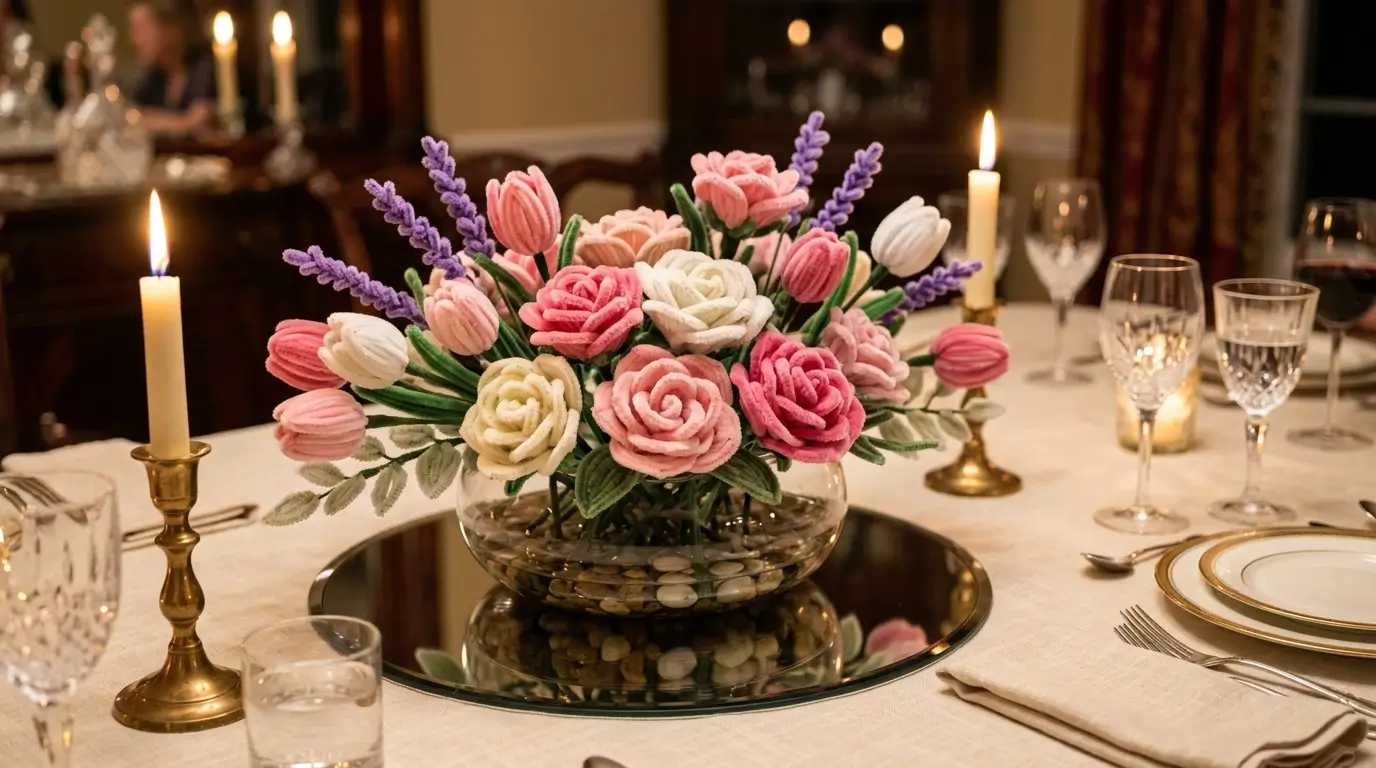
A great centerpiece needs to do one thing a regular bouquet doesn’t: look good from every angle, sit low enough for guests to talk over, and last the entire event without wilting. Pipe cleaner flowers are perfect for exactly that — they never droop, never need water, and can be built in advance without any last-minute stress.
This guide shows you how to build a full 360° table centerpiece, the technique that makes it sit at the right height, and ideas for weddings, dinner parties, and everyday table decor — all with no glue.
📄 Get the Free Centerpiece Guide PDFWhat You Need
Materials:
- 12–18 pipe cleaners in your chosen colors (hero + medium + filler flowers)
- 4–6 green pipe cleaners for stems and leaves
- A low, wide container — a shallow bowl, a wide low vase, or a cake stand
- Floral foam, pebbles, or rice — to anchor the stems upright
- Optional: a round mirror or charger plate as a base to sit the container on
Cost: $5–8 for a full centerpiece Time: 45–60 minutes
The Golden Rule of Centerpieces: Height and Width
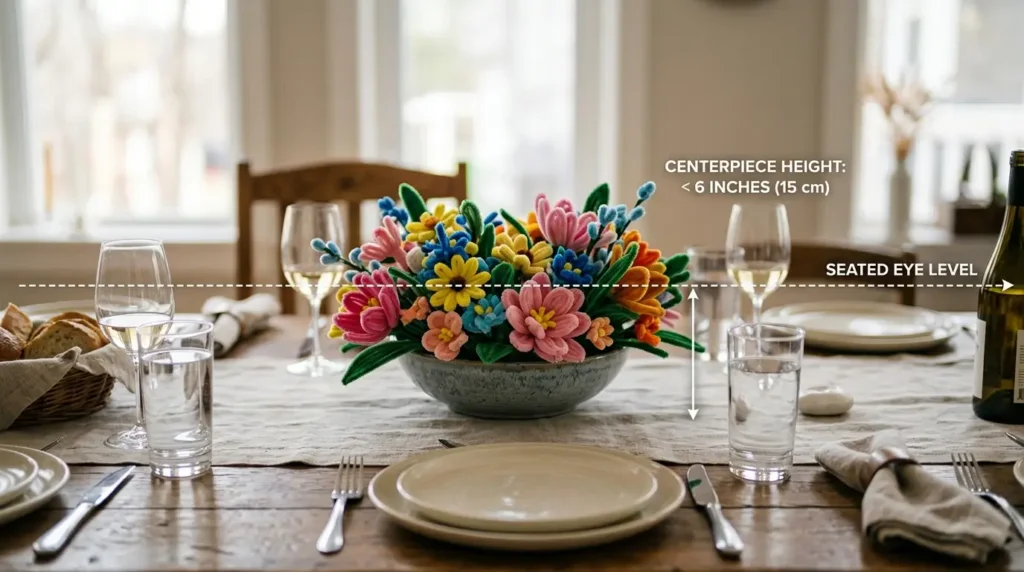
Unlike a bouquet, a centerpiece has two hard rules:
- Stay under eye level when seated. Guests need to see each other across the table — keep the finished arrangement under about 35 cm tall, including the container.
- Build for 360° viewing. There’s no “back” to hide — flowers need to face outward in every direction, not just forward.
Keep both rules in mind as you build.
Step-by-Step: Building the Centerpiece
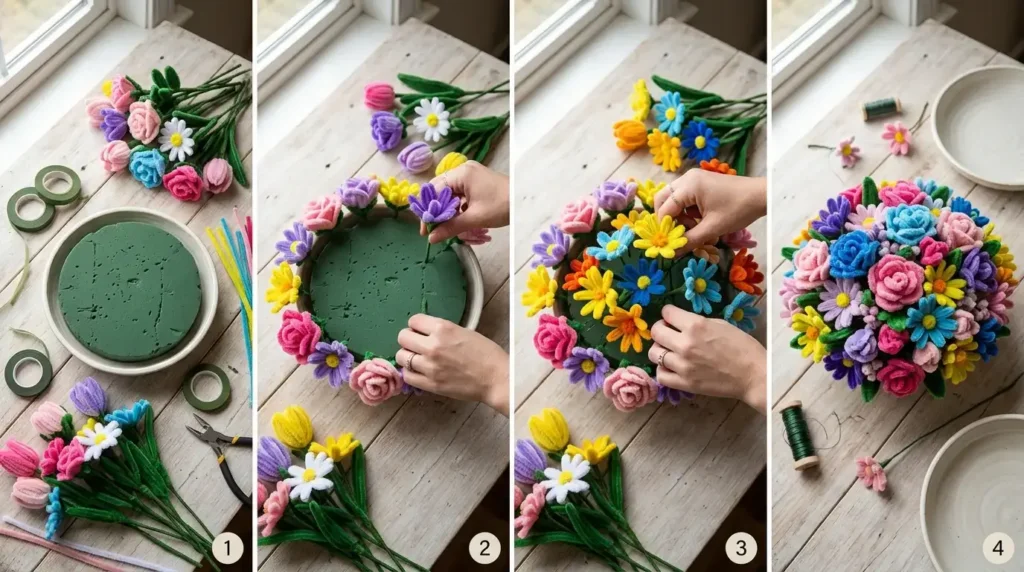
Step 1 — Prepare your flowers
Make 5–7 hero flowers (roses, sunflowers, or peonies), 4–6 medium flowers (daisies or tulips), and 4–5 filler flowers (lavender or wildflower). Double-twist every stem with 2 pipe cleaners for extra rigidity, and add at least one leaf per stem.
(See our types of pipe cleaner flowers guide for the full range of flowers to choose from.)
Step 2 — Anchor your container
Fill your low, wide container two-thirds full with floral foam, pebbles, or rice. This is what holds every stem upright and in place — skip this step and the whole centerpiece will lean or collapse.
Step 3 — Build the outer ring first
Starting from the outside edge of the container, push your medium and filler flowers in a ring around the rim, angling them slightly outward and downward. This creates the wide, low silhouette that makes a centerpiece work.
Step 4 — Build upward and inward
Add your hero flowers toward the center, standing slightly taller than the outer ring but never exceeding the 35 cm height rule. Angle a few outward at different points so there’s no single “front.”
Step 5 — Fill every gap
Walk around the table (or spin the container) and check from all sides. Fill any visible gaps with a small filler flower or leaf — a good centerpiece has no bare spots from any angle.
Step 6 — Final styling touch
Tuck a few extra leaves low around the base to hide the container rim, and give each flower head a final gentle tilt outward for a fuller, more natural look.
Centerpiece Styles for Every Occasion
💒 Wedding Reception Table
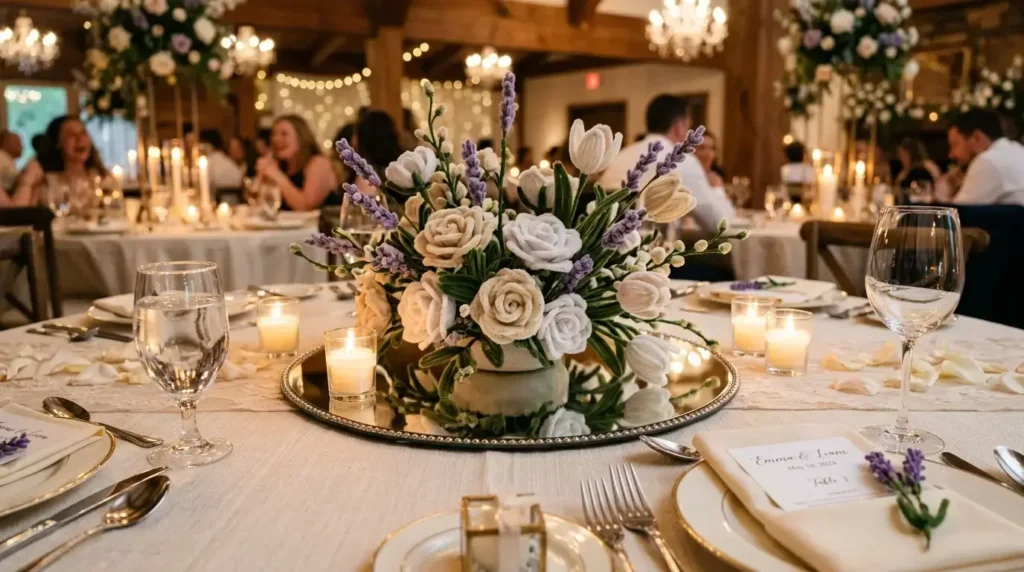
All-white or ivory roses, tulips, and lavender in a low glass bowl, with a round mirror underneath to catch the light. Make 3–4 for a full reception, one per table.
(For color and flower pairing ideas, see our pipe cleaner flower bouquet ideas guide.)
🍽️ Everyday Dinner Table
A mixed, colorful arrangement in a simple ceramic bowl — this one can stay on the table permanently since it never wilts or needs water changes.
🎉 Birthday or Celebration Table
Match the centerpiece to the party’s color theme, and add a few metallic or glitter pipe cleaner accents for a festive touch.
🍂 Seasonal Centerpiece
Swap the palette by season — pastels for spring, sunflower yellows for summer, deep rust and burgundy for autumn. See our Halloween pipe cleaner crafts guide or Easter flowers guide for two ready-made seasonal palettes.
🕯️ Minimalist Modern Table
A single hero flower type (all-white roses, for example) in a low black or gold container — simple, elegant, and quick to assemble.
Tips for a Florist-Quality Result
- Low and wide beats tall and narrow — a centerpiece should spread out, not stand up like a bouquet.
- Odd numbers of hero flowers (5 or 7) look more natural than even numbers.
- Always add foliage — bare stems read as “craft,” leaves read as “florist-made.”
- Check from a seated position, not standing — the height rule only matters relative to eye level when seated.
- Make it in advance — since it never wilts, you can build the entire centerpiece days or even weeks before the event.
FAQ
Can I make this without glue?
Yes — the entire centerpiece is built by twisting stems together and anchoring them in the container. No glue needed at any step.
How tall should a centerpiece be?
Under about 35 cm total, including the container, so guests can see and talk across the table.
How many flowers do I need for one centerpiece?
A good rule of thumb: 5–7 hero flowers, 4–6 medium flowers, and 4–5 filler flowers — around 15–18 total.
Can I reuse a centerpiece after the event?
Yes — unlike real flowers, pipe cleaner centerpieces can be disassembled and the flowers reused in bouquets, wreaths, or wall decor afterward.
What’s the best container to use?
A low, wide bowl or vase works best. Avoid tall, narrow vases — they push the arrangement above eye level and defeat the purpose of a centerpiece.
Conclusion
A centerpiece is one of the few flower arrangements where pipe cleaners genuinely outperform real flowers — no wilting, no water, no last-minute flower shop run. Build it days in advance, set it on the table, and it’ll look just as fresh at the end of the evening as it did at the start.
More guides you’ll love: