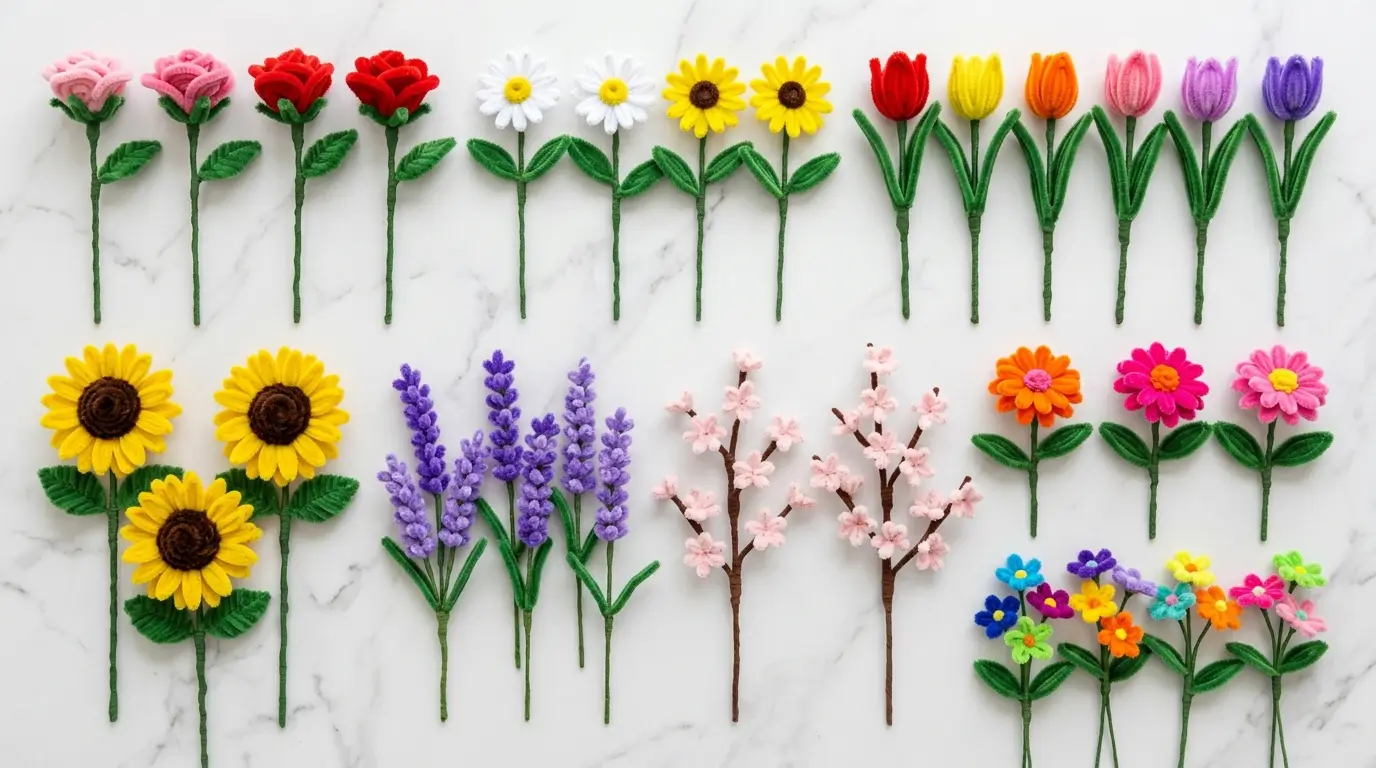
How many types of pipe cleaner flowers can you actually make?
The answer surprises most people: over 20 distinct flower types, ranging from a 3-minute wildflower that any toddler can make to a detailed double-layer rose that takes a patient 15 minutes and looks genuinely florist-made.
This is the complete guide to every type of pipe cleaner flower — what each one looks like, how it’s made, how difficult it is, and which projects it’s best suited for. Every flower links to its full step-by-step tutorial.
Consider this your master reference page for the entire pipe cleaner flower universe.
📄 Get the Free Reference Guide PDF🌸 New to pipe cleaner flowers? Start with our simple pipe cleaner flower ideas for beginners or easy pipe cleaner flowers for kids before working through this full guide.
How to Use This Guide
This guide is organized in three ways to help you find exactly what you need:
By difficulty — if you’re a beginner, start at level 1 and work upward. By category — garden flowers, wildflowers, summer flowers, foliage. By project — which flowers work best for bouquets, crowns, wall art, and more.
Every flower entry includes:
- ⏱️ Time to make
- 👶 Minimum age
- ⭐ Difficulty rating
- 🎯 Best used for
- 🔗 Link to full tutorial
Choose Your Level
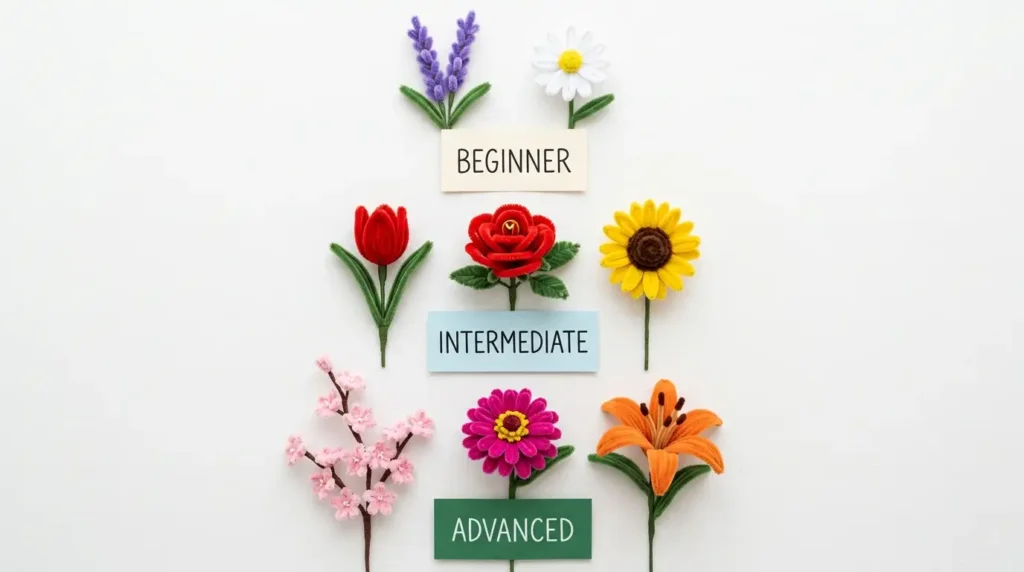
Before exploring the full list, pick your starting level:
Level 1 — Complete Beginner (no experience, under 5 min per flower) Wildflower · Lavender Sprig · Simple Loop Flower
Level 2 — Beginner (some craft experience, 5–7 min per flower) Daisy · Tulip · Rose · Sunflower · Forget-Me-Not
Level 3 — Intermediate (comfortable with twisting, 7–10 min per flower) Cherry Blossom · Zinnia · Lily · Spiral Flower · Wheat Stem
Level 4 — Advanced (patient and precise, 10–15 min per flower) Double-Layer Rose · Double-Layer Sunflower · Peony · Ranunculus · Orchid
The 6 Most Popular Types of Pipe Cleaner Flowers
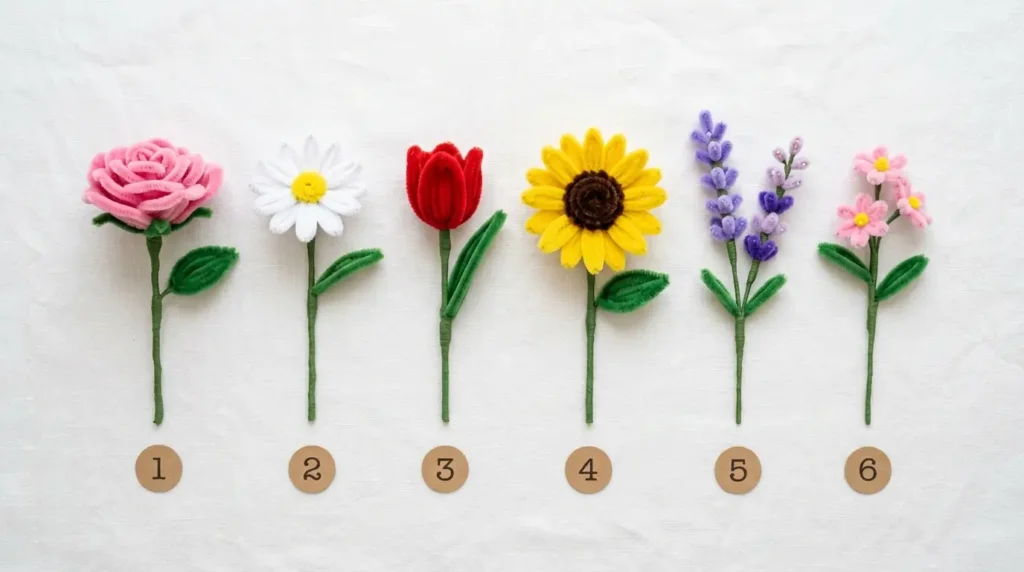
These are the six flowers that appear in almost every pipe cleaner bouquet, crown and decoration on Pinterest. Master these six and you can make virtually any arrangement.
🌹 1. Pipe Cleaner Rose
⏱️ 6 min · 👶 Age 6+ · ⭐⭐ Beginner · 🎯 Bouquets, gifts, centerpieces
The most iconic pipe cleaner flower. A tight flat spiral coiled from outside in creates a realistic rose that looks beautiful in every color. Available in every shade — from classic red and pink to white for weddings and yellow for summer.
The rose is the statement flower in almost every arrangement. When people say “pipe cleaner flower,” they usually picture a rose.
Variations: Mini rose (half-length pipe cleaner), double-layer rose (two coils), two-tone rose (two colors twisted together), ombre rose (gradient colors).
👉 Full step-by-step: pipe cleaner rose guide
🌼 2. Pipe Cleaner Daisy
⏱️ 5 min · 👶 Age 4+ · ⭐⭐ Beginner · 🎯 Bouquets, crowns, kids crafts, classroom
The most cheerful pipe cleaner flower and the best filler flower for mixed arrangements. Six white petal loops around a yellow center coil. Instantly recognizable, universally loved, and one of the fastest flowers to make once you’ve practiced the technique.
The daisy is the go-to filler flower — add it to any arrangement and it immediately looks more complete and balanced.
Variations: Multi-color daisy (colored petals instead of white), gerbera daisy (wider petals, larger center), mini daisy (4 smaller petals), daisy cluster (3 daisies sharing one stem).
👉 Full step-by-step: pipe cleaner daisy flower guide
🌷 3. Pipe Cleaner Tulip
⏱️ 5 min · 👶 Age 5+ · ⭐⭐ Beginner · 🎯 Spring bouquets, Mother’s Day, table decor
The fastest “real flower” design in pipe cleaner crafting. Three loops around a finger, a pinch, a twist — done. The tulip’s simple cup shape is created entirely by the pipe cleaner’s own tension, no shaping required.
The tulip is the easiest flower that looks sophisticated. It’s the one most people choose for gifts because it photographs beautifully and looks elegant without requiring advanced skill.
Variations: Open tulip (top flared wider), parrot tulip (frilly edge created by curling the rim), two-tone tulip (two colors twisted before wrapping), mini tulip (thinner loops).
👉 Full step-by-step: pipe cleaner tulip guide
🌻 4. Pipe Cleaner Sunflower
⏱️ 7 min · 👶 Age 6+ · ⭐⭐ Beginner · 🎯 Summer bouquets, home decor, kids crafts
Eight yellow petal loops around a dark brown center coil. The sunflower is bold, bright and immediately makes any arrangement feel alive with summer energy. One of the most saved pipe cleaner flowers on Pinterest.
The sunflower is the hero flower for summer — the one that makes a bouquet look warm and joyful rather than formal.
Variations: Mini sunflower (shorter petals), double-layer sunflower (inner and outer petal ring), sunset sunflower (orange petals), giant sunflower (9–10 longer petals).
👉 Full step-by-step: pipe cleaner sunflower guide
💜 5. Pipe Cleaner Lavender
⏱️ 3 min · 👶 Age 4+ · ⭐ Easiest · 🎯 Bouquet filler, home decor, crowns, gifts
Tiny purple loops twisted along a bare green stem. The fastest pipe cleaner flower by far, and the most versatile — it works as a filler in every bouquet style, adds height and color contrast, and looks beautiful displayed alone as a Provençal bunch.
Lavender is the secret weapon flower — crafters who add it to every arrangement immediately see their work look more professional.
Variations: Soft lilac (pale purple), deep violet (dark purple), French blue (blue-purple), mixed-shade bunch (two shades in one bundle).
👉 Full step-by-step: lavender pipe cleaner flowers guide
🌿 6. Pipe Cleaner Wildflower
⏱️ 3 min · 👶 Age 3+ · ⭐ Easiest · 🎯 Kids crafts, rainbow bouquets, quick filler
The absolute simplest pipe cleaner flower — fold a pipe cleaner in half three times and twist the center once. The loops fan out naturally. Every child aged 3 and up can make this independently.
The wildflower is the gateway flower — it’s the one most people make first, get immediately hooked, and use as the starting point for learning more complex designs.
Variations: Any color works. Mix 6–8 wildflowers of different colors for an instant rainbow bouquet. Pair with larger flowers as filler.
👉 More easy designs: simple pipe cleaner flower ideas
4 Categories of Pipe Cleaner Flowers
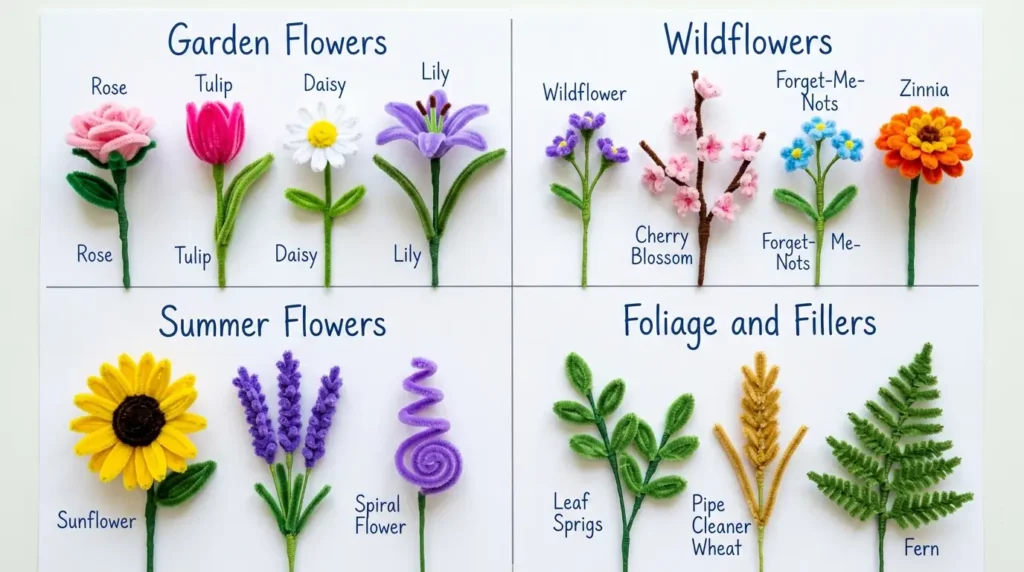
Every pipe cleaner flower falls into one of four categories. Understanding the categories helps you build better arrangements.
🌹 Category 1 — Garden Flowers
The classic garden flowers that form the core of most pipe cleaner arrangements. These are the flowers people recognize immediately and respond to most strongly.
Rose — The queen of the garden and the most photographed pipe cleaner flower. Use as a hero flower in any arrangement.
Tulip — The most elegant spring flower. Perfect for Mother’s Day, Easter and spring table decor.
Daisy — The most cheerful garden flower. Use as filler between larger statement flowers.
Lily — Six long graceful curved petals with a prominent yellow stamen center. More advanced but strikingly beautiful. Perfect for wedding arrangements and elegant home decor.
Peony — Multiple layers of ruffled petals in a full, lush dome shape. One of the most advanced pipe cleaner flowers but the most spectacular result. Use as a centerpiece focal point.
Carnation — Ruffled loops twisted around a center, creating a full fluffy flower. Easier than it looks. Beautiful in soft pink or white.
🌸 Category 2 — Wildflowers & Delicate Flowers
Lighter, more delicate flowers that add organic texture and visual interest to arrangements. These are the flowers that make bouquets look hand-picked from a meadow rather than designed by a florist.
Wildflower — The fold-and-twist design. Any color, any size. The fastest flower in this entire guide.
Cherry Blossom — Tiny 5-petal blossoms clustered on a Y-shaped brown branch. More complex but uniquely beautiful. Perfect for spring and Japanese-inspired designs. See our full easy spring pipe cleaner flowers craft for kids for the technique.
Forget-Me-Not — Tiny blue 5-petal flowers clustered together on one stem. Delicate and detailed. Perfect as filler in white and blue arrangements.
Wildflower Cluster — 4–6 tiny 3-petal flowers clustered on a single stem. Creates a loose, organic texture between larger flowers.
Poppy — 4–5 large, slightly crinkled petals in red or orange around a dark center. Dramatic and bold. Beautiful in summer wildflower arrangements.
☀️ Category 3 — Summer & Seasonal Flowers
Flowers associated with specific seasons or occasions that give an arrangement an instant seasonal identity.
Sunflower — Summer’s defining flower. Yellow and bold. Use as hero flower for summer and autumn arrangements.
Lavender — Provençal, calm and versatile. Works in every season but peaks in late spring and summer.
Zinnia — Tight multi-layered coil with alternating up-down petals. Bold colors — orange, hot pink, yellow. The most striking summer accent flower.
Spiral Flower — A loose single-color coil with petals curved in a spiral rather than flat. Abstract and modern. Beautiful in single-color statement arrangements.
Marigold — Dense layers of small orange and yellow petals. Perfect for autumn and Day of the Dead themed arrangements.
Poinsettia — Star-shaped red and green arrangement. The most recognizable Christmas flower. Use red pipe cleaners for the bracts and green for the leaves. See our pipe cleaner flowers Christmas guide for the full tutorial.
🌿 Category 4 — Foliage & Filler Elements
Not flowers at all — but essential to making any arrangement look complete, balanced and professional.
Leaf Sprig — The single most important non-flower element. A folded green oval twisted onto any stem. Adds realism and fills visual gaps. Every stem should have at least one.
Fern Branch — Multiple small leaf loops along a long green stem, alternating left and right. Creates a delicate, lacy texture. Perfect for bouquets and wedding arrangements.
Wheat Stem — Small teardrop loops along a stem, alternating left and right. Adds height and a rustic, harvest aesthetic. Beautiful in autumn arrangements.
Vine Tendril — A loosely coiled green pipe cleaner with small leaf loops. Used in garlands and wall decorations to connect flower clusters.
Berry Cluster — 3–5 small tight coils twisted together on a short stem. Perfect as accent in winter and Christmas arrangements.
All 20+ Types — Quick Reference Table
| Flower | Category | Difficulty | Time | Best For |
|---|---|---|---|---|
| Wildflower | Wildflower | ⭐ | 3 min | Kids, filler |
| Lavender | Summer | ⭐ | 3 min | Filler, décor |
| Daisy | Garden | ⭐⭐ | 5 min | Bouquets, crowns |
| Tulip | Garden | ⭐⭐ | 5 min | Spring, gifts |
| Rose | Garden | ⭐⭐ | 6 min | Hero flower |
| Sunflower | Summer | ⭐⭐ | 7 min | Summer, décor |
| Carnation | Garden | ⭐⭐ | 6 min | Weddings, gifts |
| Spiral Flower | Summer | ⭐⭐ | 6 min | Modern décor |
| Forget-Me-Not | Wildflower | ⭐⭐ | 5 min | Blue arrangements |
| Cherry Blossom | Wildflower | ⭐⭐⭐ | 8 min | Spring, Japanese |
| Zinnia | Summer | ⭐⭐⭐ | 7 min | Bold colour |
| Lily | Garden | ⭐⭐⭐ | 9 min | Weddings, elegant |
| Poppy | Wildflower | ⭐⭐⭐ | 7 min | Summer, meadow |
| Marigold | Seasonal | ⭐⭐⭐ | 8 min | Autumn |
| Wheat Stem | Foliage | ⭐⭐ | 4 min | Rustic filler |
| Fern Branch | Foliage | ⭐⭐ | 5 min | Bouquet filler |
| Double Rose | Garden | ⭐⭐⭐⭐ | 12 min | Wedding, hero |
| Double Sunflower | Summer | ⭐⭐⭐⭐ | 12 min | Summer statement |
| Peony | Garden | ⭐⭐⭐⭐ | 15 min | Centerpiece |
| Poinsettia | Seasonal | ⭐⭐⭐ | 10 min | Christmas |
| Ranunculus | Garden | ⭐⭐⭐⭐ | 15 min | Wedding, luxury |
Which Flowers Work Best for Each Project
Not every flower works in every context. Here’s the honest guide to which types to choose for different projects:
💐 For Bouquets
Hero flowers (1–3): Rose, Tulip, Sunflower, Lily, Peony Medium flowers (2–3): Daisy, Carnation, Zinnia, Cherry Blossom Filler flowers (2–4): Lavender, Forget-Me-Not, Wildflower Foliage (1–2 per stem): Leaf Sprig, Fern Branch
Full assembly guide: pipe cleaner flower bouquet ideas
👑 For Flower Crowns
Best choices: Daisy, Mini Rose, Wildflower, Cherry Blossom, Lavender Sprig, Mini Tulip Why: Smaller flowers sit flatter and attach more easily to the crown base. Large flowers like full roses and sunflowers are too heavy and bulky for crowns.
Full crown guide: pipe cleaner flower crown
🖼️ For Wall Decoration
Best choices: Rose, Daisy, Sunflower, Wildflower, Lavender, Cherry Blossom Why: Flat-backed flowers sit flush against walls. Roses and daisies have the flattest backs. Lavender adds height and texture vertically.
Full wall decor guide: pipe cleaner flower wall decoration
🏠 For Home Decor Arrangements
Best choices: Rose, Lavender, Sunflower, Lily, Wildflower, Fern Branch Why: Home décor benefits from variety — mix statement flowers with delicate fillers for the most natural-looking small arrangements.
Full home décor guide: small pipe cleaner flower arrangements for home decor
💒 For Weddings
Best choices: White Rose, Ivory Tulip, Cherry Blossom, Lily, White Wildflower, Lavender, Fern Why: Weddings require elegant restraint — fewer flower types in a cohesive white and ivory palette. The double-layer rose is worth the extra time for wedding arrangements.
Full wedding guide: pipe cleaner wedding flowers
🏫 For Classroom Crafts
Best choices: Wildflower, Lavender, Daisy, Tulip Why: These four flowers cover the full age range from 3 to 12 and require no scissors. All four can be made in under 5 minutes, which fits a standard craft session.
Full classroom guide: pipe cleaner flowers classroom decoration
🎁 For Kids (Ages 3–8)
Best choices: Wildflower, Lavender, Daisy, Tulip, Simple Sunflower Why: These flowers use the simplest techniques — folding, looping and basic twisting — that small hands can manage. All five are achievable without adult assistance by age 6.
Full kids guide: easy pipe cleaner flowers for kids
How to Mix Flower Types for the Best Arrangements
Understanding flower types is only half the skill. The other half is knowing how to combine them. These are the mixing rules that professional florists use — and they work just as well for pipe cleaner arrangements:
The 1-3-5 rule: 1 hero flower (large, statement) + 3 medium flowers + 5 filler flowers. This ratio creates a visually balanced arrangement that feels full without being crowded.
Always include foliage. No matter which flowers you choose, add at least one leaf to every stem. Foliage is what separates “bunch of flowers” from “bouquet.”
Use the color triangle. Choose 3 colors. Place each color at a different “point” of the arrangement so no two flowers of the same color sit directly next to each other.
Mix textures, not just colors. A bouquet of all roses is beautiful but flat. Add a spiky lavender, a soft daisy and a bold sunflower to the same arrangement and the textural variety makes it come alive.
Scale to the vase. Small bud vase → 1–3 flowers. Medium vase → 5–7 flowers. Large centerpiece vase → 10–15 flowers. The flowers should always extend above the vase rim by at least the height of the vase itself.
Seasonal Guide — Which Types to Make When
| Season | Best flower types | Why |
|---|---|---|
| Spring | Tulip, Daisy, Cherry Blossom, Lavender | These are the flowers that bloom in spring — seasonally resonant and highly searched March–May |
| Summer | Sunflower, Zinnia, Wildflower, Lavender, Rose | Bold, bright flowers that match summer energy. Peak Pinterest engagement June–August |
| Autumn | Marigold, Wheat Stem, Zinnia (warm tones), Rose (deep red) | Warm orange and burgundy tones. High search volume September–October |
| Winter/Christmas | Poinsettia, Berry Cluster, White Rose, Lavender | Seasonal décor peak. The most searched pipe cleaner flower types November–December |
Frequently Asked Questions
How many types of pipe cleaner flowers can you make?
Over 20 distinct flower types, from the 3-minute wildflower to the advanced 15-minute peony. Every common garden flower, wildflower and seasonal flower has a pipe cleaner equivalent using variations of the same core techniques — coiling, looping and twisting.
What is the easiest type of pipe cleaner flower to make?
The wildflower is the absolute easiest — fold a pipe cleaner in half three times and twist the center once. Total time: 3 minutes. Any child aged 3 and up can make it independently. The lavender sprig is equally simple at 3 minutes.
What is the most popular type of pipe cleaner flower?
The rose is consistently the most searched, most made and most photographed pipe cleaner flower worldwide. The daisy and sunflower are close second and third.
Which pipe cleaner flower looks most like the real thing?
The double-layer rose most closely resembles a real rose when made carefully with tight coils and proper shaping. The lavender sprig also photographs remarkably realistically. The tulip is often mistaken for real at a distance.
What flowers should a complete beginner start with?
Start with the wildflower (3 min), then the lavender sprig (3 min), then the daisy (5 min). These three in combination already make a beautiful small bouquet and teach every core technique you need for all other flowers.
Which pipe cleaner flowers are best for a mixed bouquet?
For a classic mixed bouquet: roses as hero flowers, daisies or tulips as medium flowers, lavender as filler, and leaf sprigs on every stem. This combination works in every color palette and every occasion.
Final Thoughts
The pipe cleaner flower world is bigger than most people realize — and the variety of what you can make with one simple material never stops being surprising.
Whether you start with a wildflower today and work your way to a double-layer rose over the next few weeks, or jump straight to a complex cherry blossom branch — every type on this list is achievable, beautiful and worth making.
Bookmark this page. Come back to it every time you want to try a new flower type. It will always be here.
Happy crafting — from My Flower Decor! 🌸
Save to Pinterest — the most comprehensive pipe cleaner flower guide on the internet! 📌
All flower tutorials:
- Pipe cleaner rose
- Pipe cleaner daisy flower
- Pipe cleaner tulip
- Pipe cleaner sunflower
- Lavender pipe cleaner flowers
- Easy pipe cleaner flowers for kids
- Simple pipe cleaner flower ideas
- Pipe cleaner flower bouquet ideas
- Pipe cleaner flower crown
- Pipe cleaner flower wall decoration
- Easy spring pipe cleaner flowers craft for kids
- Pipe cleaner wedding flowers
- Pipe cleaner flowers classroom decoration
- Small pipe cleaner flower arrangements for home decor
Download the free complete types guide PDF— print the master reference sheet